
R&D Tax Relief
What You Need To Know

Claim Notification
For accounting periods beginning on or after 1 April 2023, companies must notify HMRC in advance of their intention to claim, using HMRC's digital claim notification form. If the form is not submitted within the claim notification period, the R&D claim is invalid.
You must submit a claim notification form if:
-
you are claiming R&D tax relief for the first time; or
-
your last claim was made more than three years before the last date of your claim notification period.
Your claim notification period starts on the first day of your period of account and ends six months after the end of that period of account. Note that this runs from the period of account, not the accounting period — where a period of account exceeds 12 months and covers two accounting periods, the claim notification period is the same for both, and you only need to submit one form.
Two exceptions catch companies that would otherwise assume they are exempt. You will still need to notify if HMRC rejected a previous claim by removing it from your Company Tax Return, or if you claimed for an accounting period beginning before 1 April 2023 by amending your return and that amendment was received on or after 1 April 2023.
Claim Deadline
Companies generally have two years from the end of an accounting period to make an R&D claim — this is the normal window for amending a Company Tax Return. We can prepare claims quickly where that deadline is close, but we strongly recommend starting the substantive claim process at least six weeks beforehand. Bear in mind that a claim notification, where required, must be submitted by the end of the claim notification period — which can fall well before the two-year amendment deadline.
Why Claim? The Benefit of R&D Tax Relief
SME v. Large
(This section applies to earlier accounting periods that may still be within the claim window. For periods beginning on or after 1 April 2024, see the merged scheme below.)
For accounting periods starting before 1st April 2024, the Research and Development Expenditure Credit (RDEC) and Small or medium sized enterprise (‘SME’) schemes apply. The cash benefit a company receives from claiming R&D Tax Reliefs depends on whether it qualifies as an SME or under the RDEC.
It can be complex to determine whether a company is an SME as the wider group and investors also need to be considered. In particular, the ownership structure of the company must be examined and a proportion of the results of any enterprises which hold 25% or more of the share capital must be added together before the above thresholds are tested. There are exclusions and each case should be examined before the claim is made.
The Merged Scheme and ERIS (accounting periods beginning on or after 1 April 2024)
The merged scheme R&D expenditure credit (RDEC) and enhanced R&D intensive support (ERIS) replaced the previous RDEC and SME schemes for accounting periods beginning on or after 1 April 2024. The merged scheme gives a 20% above-the-line credit on qualifying expenditure, typically worth an effective net benefit of around 15–16.2% depending on the corporation tax rate that applies. Loss-making, R&D-intensive SMEs — those spending at least 30% of total expenditure on R&D — may instead claim under ERIS, worth up to 27%. The expenditure rules for both are the same; the calculation differs.
Qualifying Costs
So, you think that your company might be doing R&D, but what are the costs that can be included in the claim?
Although the SME and the RDEC regimes are very similar, and they share the same definition of qualifying R&D, the costs which can be included in an R&D claim differ slightly different depending on which regime you fall into, as follows:
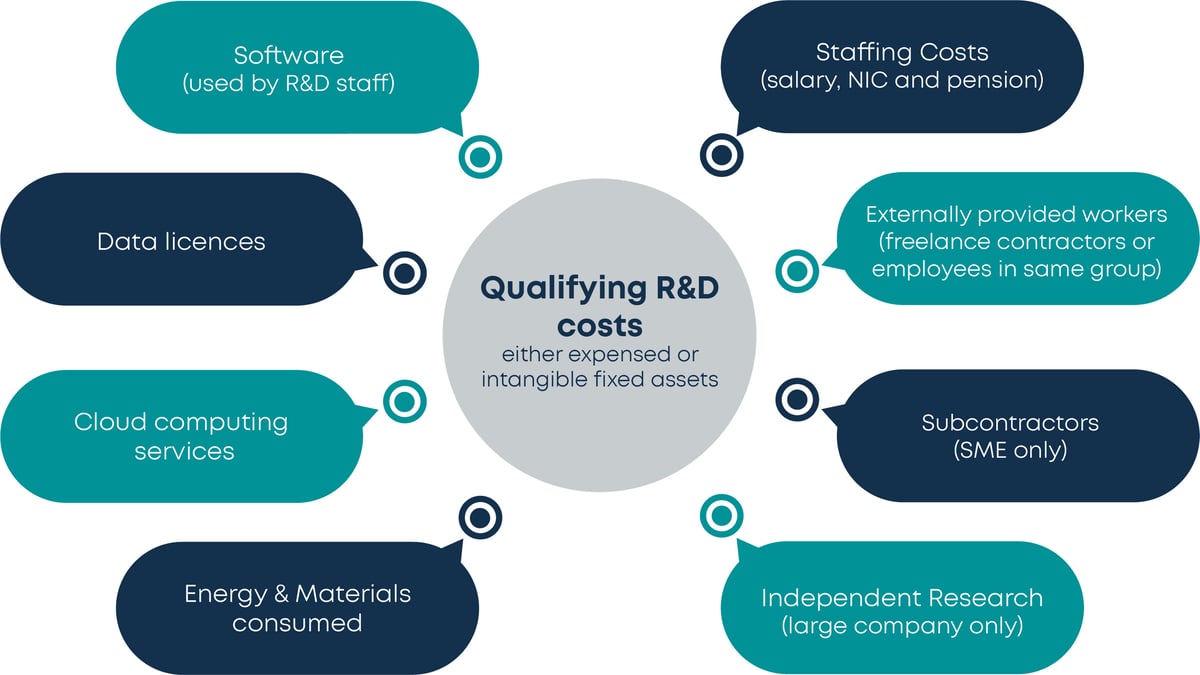
Additionally, the definition of R&D for tax reliefs will be expanded to include all mathematics – clarifying in particular that ‘pure maths’ can qualify.
The previously announced restriction on some overseas expenditure will now come into effect from 1 April 2024 instead of 1 April 2023. This will allow the government to consider the interaction between this restriction and the design of a potential merged R&D relief which has been consulted on recently.
Seeking detailed information on innovation tax reliefs? Our Innovation Tax Reliefs service page offers insights into how we help businesses optimise their claims from beginning to end.
📞 For more information, call 02080371030 or complete the form on the bottom of this page and a member of our R&D team will come back to you.
Innovation Tax Relief Service Team




.png)

























.png)






%20(1).png)






%20(1).png)



.png)







.png)
.png)
Recent News